🌍 Earth
The Blue Planet
Quick Facts
Overview
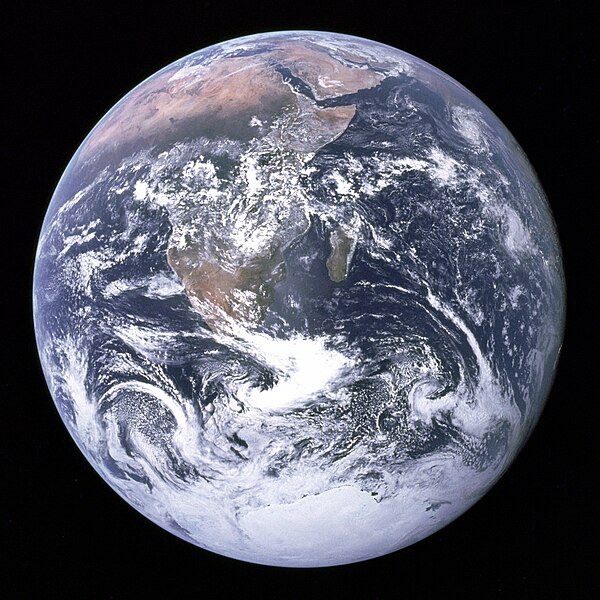
Earth is the third planet from the Sun and the only astronomical object known to harbor life. About 71% of Earth's surface is covered with water, and the atmosphere is rich in nitrogen and oxygen. Earth's distance from the Sun, physical properties, and geological history have allowed life to evolve and thrive. The planet has one natural satellite, the Moon, which plays a crucial role in stabilizing Earth's axial tilt and creating tides. Earth is the largest of the four rocky planets in the inner solar system.
Structure and Composition
Earth has a layered structure consisting of a solid inner core, a liquid outer core, a viscous mantle, and a solid crust. The inner core is primarily iron-nickel, about 1,220 km in radius. The outer core extends to about 3,400 km from the center. The mantle makes up about 84% of Earth's volume. The crust varies from 5-70 km thick. Earth's magnetic field is generated by the movement of liquid iron in the outer core, protecting us from harmful solar radiation.
Atmosphere
Earth's atmosphere is composed of 78% nitrogen, 21% oxygen, and 1% other gases including argon, carbon dioxide, and water vapor. The atmosphere is divided into five layers: troposphere (weather occurs here), stratosphere (contains the ozone layer), mesosphere, thermosphere, and exosphere. The atmosphere protects life by absorbing ultraviolet radiation, warming the surface through heat retention (greenhouse effect), and reducing temperature extremes between day and night.
Surface Features
Earth's surface is dominated by oceans (71%) and continents (29%). The planet features diverse landscapes including mountains, valleys, plains, deserts, and polar ice caps. The highest point is Mount Everest at 8,849 meters above sea level, while the deepest point is the Mariana Trench at 10,994 meters below sea level. Earth is geologically active with plate tectonics constantly reshaping the surface, causing earthquakes, volcanic eruptions, and mountain formation.
Earth Observation
Landsat Program
1972-present
Longest-running enterprise for satellite monitoring of Earth
Terra & Aqua
1999-present
NASA satellites studying Earth's climate and environment
ISS
1998-present
International Space Station continuously observing Earth
GOES Satellites
1975-present
Weather monitoring and disaster prevention
Interesting Facts
- ✨Earth is the only planet not named after a god
- ✨The Earth's rotation is gradually slowing down
- ✨Earth has the highest density of any planet in the solar system
- ✨About 70% of Earth's oxygen is produced by ocean plants
- ✨The Earth's core is as hot as the surface of the Sun (≈6,000°C)
- ✨Earth's magnetic field is weakening and may flip poles in the future
- ✨The Moon is slowly drifting away from Earth at about 3.8 cm per year
- ✨Earth is the only planet where water can exist in all three states
- ✨Lightning strikes Earth about 100 times per second
Name and History
The name "Earth" is derived from Old English and Germanic words meaning "ground" or "soil." It's the only planet whose English name doesn't derive from Greek or Roman mythology. Throughout history, many cultures believed Earth was flat until ancient Greek philosophers provided evidence for a spherical Earth. Today, Earth Day is celebrated annually on April 22 to demonstrate support for environmental protection.