♃ Jupiter
The Gas Giant King
Quick Facts
Overview
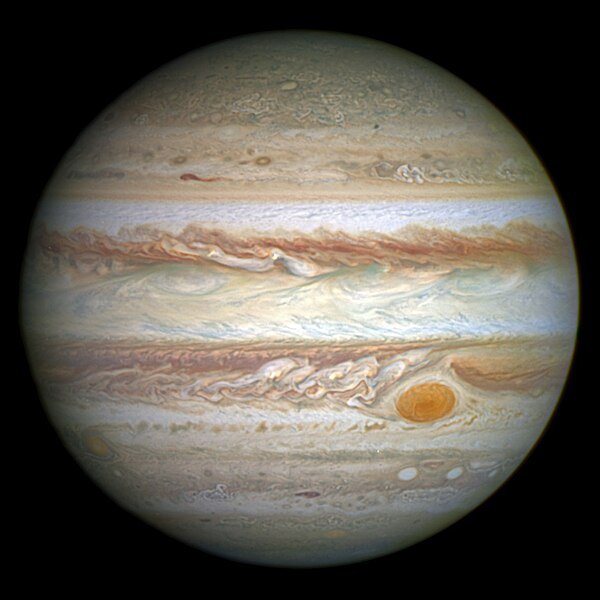
Jupiter is the fifth planet from the Sun and the largest in the solar system. It's a gas giant with a mass more than twice that of all other planets combined. Jupiter is known for its Great Red Spot, a massive storm larger than Earth that has been raging for at least 400 years. The planet rotates faster than any other planet, completing a day in less than 10 hours. Jupiter has a faint ring system and at least 95 moons, including the four large Galilean moons discovered by Galileo in 1610.
Structure and Composition
Jupiter is primarily composed of hydrogen (90%) and helium (10%), similar to the Sun. The planet likely has a rocky core about 10 times Earth's mass, surrounded by a layer of metallic hydrogen (hydrogen under such pressure it acts like a metal). Above this is a layer of liquid molecular hydrogen, then the visible atmosphere. Jupiter radiates more heat than it receives from the Sun, suggesting continued gravitational contraction or other internal heat sources.
Atmosphere
Jupiter's atmosphere features colorful bands of clouds made of ammonia crystals moving at different speeds. The lighter bands are called zones, and the darker bands are called belts. Lightning storms in Jupiter's atmosphere can be thousands of times more powerful than those on Earth. The Great Red Spot is an anticyclonic storm that has shrunk significantly in recent decades. Jupiter's atmosphere has no solid surface—it gradually transitions into the liquid interior.
Atmospheric Features
Jupiter has no solid surface—it's a ball of gas and liquid. The "surface" we see is the top of its atmosphere. The atmospheric pressure and temperature increase with depth. Notable features include the Great Red Spot, smaller storms called white ovals and brown barges, and intricate cloud patterns. Jupiter's fast rotation creates strong winds reaching speeds of 400 km/h, forming distinct latitudinal bands.
Exploration History
Pioneer 10 & 11
1973-1974
First spacecraft to visit Jupiter and photograph it
Voyager 1 & 2
1979
Detailed study of Jupiter and its moons, discovered rings
Galileo
1995-2003
First spacecraft to orbit Jupiter, studied atmosphere and moons
Juno
2016-present
Studying Jupiter's atmosphere, magnetic field, and interior
Interesting Facts
- ✨Jupiter is so massive it could fit all other planets inside it
- ✨The Great Red Spot is a storm larger than Earth
- ✨Jupiter has the strongest magnetic field of any planet—20,000 times stronger than Earth's
- ✨A day on Jupiter lasts less than 10 hours, despite its enormous size
- ✨Jupiter acts as a "cosmic vacuum cleaner," protecting inner planets from asteroids
- ✨Europa, one of Jupiter's moons, may have an ocean beneath its ice that could harbor life
- ✨Jupiter has faint rings made of dust from its moons
- ✨The planet emits radio waves strong enough to be detected on Earth
- ✨If Jupiter were 80 times more massive, it would have become a star
Name and Mythology
Jupiter is named after the king of the Roman gods (equivalent to Greek Zeus). The planet's four largest moons—Io, Europa, Ganymede, and Callisto—are named after lovers of Zeus in Greek mythology. The planet has been known since ancient times and was sacred to the god Jupiter/Zeus, fitting for the largest and most dominant planet in the solar system.