♂️ Mars
The Red Planet
Quick Facts
Overview
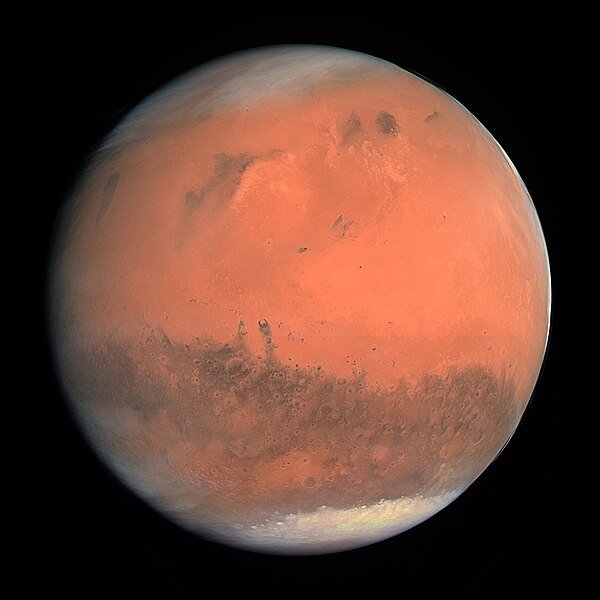
Mars is the fourth planet from the Sun and the second-smallest planet in the solar system. Often called the "Red Planet" due to iron oxide (rust) on its surface, Mars has been a focus of human fascination and space exploration. The planet has the largest volcano in the solar system (Olympus Mons) and the deepest canyon (Valles Marineris). Mars has polar ice caps made of water and carbon dioxide ice. Evidence suggests Mars once had liquid water on its surface, raising questions about past life.
Structure and Composition
Mars has a dense core made of iron, nickel, and sulfur, with a radius of about 1,800 km. The mantle is silicate rock, about 1,300 km thick. The crust averages 50 km thick (thicker than Earth's). Mars has no active plate tectonics, but evidence of past volcanic activity is abundant. The planet's reddish color comes from iron oxide (rust) prevalent in the regolith (surface material).
Atmosphere
Mars has a thin atmosphere, about 1% the density of Earth's, composed mainly of carbon dioxide (95%), nitrogen (3%), and argon (1.6%). The thin atmosphere means temperatures vary wildly between day and night. Dust storms can envelope the entire planet for months. Mars experiences seasons due to its axial tilt similar to Earth's. The atmosphere once may have been thicker, but solar wind stripped much of it away over billions of years.
Surface Features
Mars has a diverse landscape with massive volcanoes, deep canyons, and ancient river valleys. Olympus Mons is 21 km high—nearly 2.5 times taller than Mount Everest. Valles Marineris is 4,000 km long and up to 7 km deep. The northern hemisphere has smooth plains, while the southern hemisphere is heavily cratered. Polar ice caps grow and shrink with the seasons. Recent discoveries show possible liquid water beneath the surface.
Exploration History
Viking 1 & 2
1976
First successful Mars landers, searched for signs of life
Mars Pathfinder
1997
First rover (Sojourner) to explore Mars surface
Spirit & Opportunity
2004-2018
Twin rovers that discovered evidence of past water
Curiosity
2012-present
Car-sized rover investigating Mars' habitability
Perseverance
2021-present
Searching for ancient life and collecting samples for return to Earth
Interesting Facts
- ✨A year on Mars lasts 687 Earth days, nearly twice as long as Earth's year
- ✨Mars has the tallest volcano in the solar system—Olympus Mons at 21 km
- ✨The Valles Marineris canyon could stretch across the entire United States
- ✨Mars has the largest dust storms in the solar system, lasting for months
- ✨Sunsets on Mars appear blue due to how dust scatters light
- ✨Mars has two small moons, Phobos and Deimos, probably captured asteroids
- ✨The planet is named after the Roman god of war
- ✨Mars' atmosphere is so thin that water instantly turns to vapor
- ✨Evidence suggests Mars once had an ocean covering much of its northern hemisphere
Name and Mythology
Mars is named after the Roman god of war, due to its blood-red color. The ancient Greeks called it Ares. The planet's two moons, Phobos and Deimos, are named after the sons of Ares (Fear and Panic). Mars has been known since ancient times and plays a prominent role in science fiction, often portrayed as a potential home for alien life or future human colonization.