☿️ Mercury
The Swift Messenger
Quick Facts
Overview
Mercury is the smallest planet in our solar system and the closest to the Sun. Named after the Roman messenger god, it's the fastest planet, completing an orbit around the Sun in just 88 days. Despite being closest to the Sun, it's not the hottest planet—that honor goes to Venus. Mercury has extreme temperature variations, from -173°C at night to 427°C during the day.
Structure and Composition
Mercury has a large metallic core that makes up about 75% of the planet's diameter. The core is thought to be molten and contains iron. The mantle is only 400-600 km thick, and the crust is believed to be 100-300 km thick. The planet's high density suggests it has a higher proportion of metal than any other planet in the solar system.
Atmosphere
Mercury has an extremely thin exosphere rather than a true atmosphere. It contains oxygen, sodium, hydrogen, helium, and potassium, but the atmospheric pressure is less than one-trillionth that of Earth's. Solar radiation constantly strips away Mercury's atmosphere, which is continuously replenished by solar wind and radioactive decay.
Surface Features
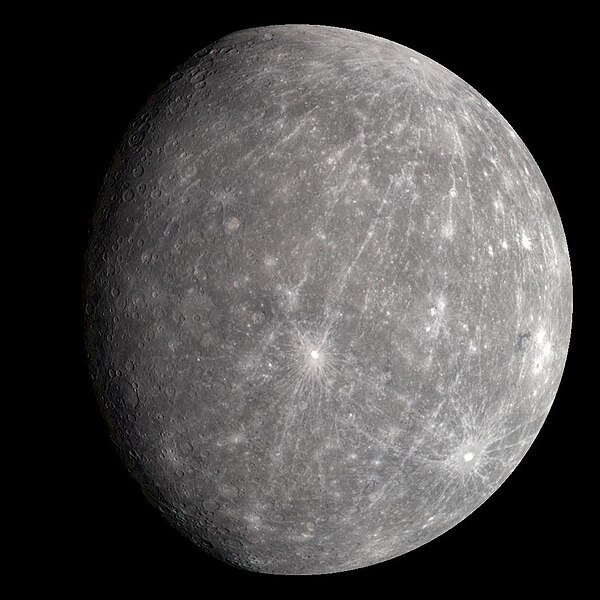
Mercury's surface is heavily cratered and resembles Earth's Moon. The largest crater, Caloris Basin, is about 1,550 km in diameter. The planet also has unusual features called "hollows"—shallow depressions that appear bright because they're relatively young. Plains between craters suggest ancient volcanic activity.
Exploration History
Mariner 10
1974-1975
First spacecraft to visit Mercury, mapped 45% of its surface
MESSENGER
2011-2015
First spacecraft to orbit Mercury, mapped the entire planet
BepiColombo
2018-2025 (arrival)
Joint ESA-JAXA mission, currently en route to study Mercury in detail
Interesting Facts
- ✨Mercury has no seasons because its axis has almost no tilt
- ✨A day on Mercury (sunrise to sunrise) lasts 176 Earth days
- ✨Mercury is shrinking! As its core cools, the planet is slowly getting smaller
- ✨Ice exists at Mercury's poles, hidden in permanently shadowed craters
- ✨Mercury has a "tail" like a comet—sodium atoms streaming from its surface
- ✨The Sun appears 3 times larger from Mercury than from Earth
- ✨Mercury has no natural satellites or rings
- ✨Standing on Mercury, you could see the Sun rise, stop, reverse, and then continue rising
Name and Mythology
Mercury is named after the Roman god Mercury, the messenger of the gods, known for his speed. The planet was given this name because it moves quickly across the sky. Ancient civilizations have known about Mercury since at least 3000 BC. The Greeks called it both Apollo (when visible in the morning) and Hermes (when visible in the evening).