♆ Neptune
The Windy Blue Giant
Quick Facts
Overview
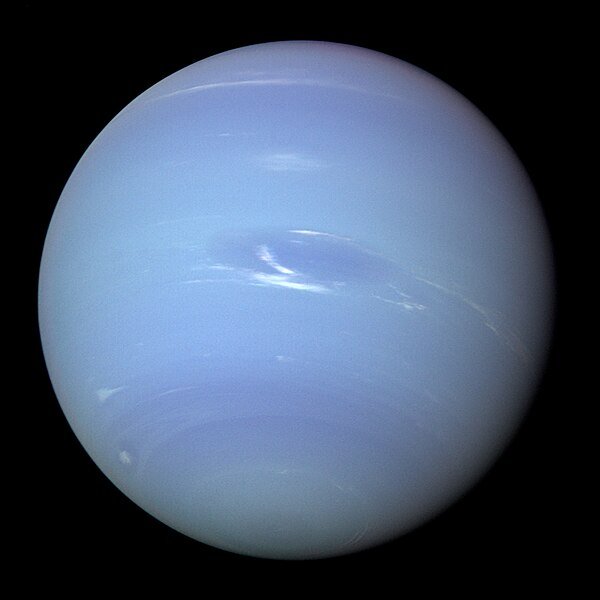
Neptune is the eighth and farthest planet from the Sun in the solar system. It's the fourth-largest planet by diameter and third-largest by mass. Neptune is an ice giant with the strongest winds in the solar system, reaching speeds of 2,100 km/h. The planet appears deep blue due to methane in its atmosphere. Neptune was the first planet discovered through mathematical prediction rather than observation, based on irregularities in Uranus's orbit. It has 14 known moons, with Triton being the largest.
Structure and Composition
Neptune's interior structure is similar to Uranus—a rocky core surrounded by a mantle of water, methane, and ammonia ices, topped by an atmosphere of hydrogen, helium, and methane. The core is about 1.2 Earth masses. Unlike Uranus, Neptune radiates 2.6 times more energy than it receives from the Sun, suggesting an internal heat source, possibly from gravitational compression or chemical reactions in the interior.
Atmosphere
Neptune's atmosphere is composed of hydrogen (80%), helium (19%), and methane (1.5%). The methane gives Neptune its striking blue color. The planet has the strongest sustained winds of any planet, with storms and dark spots appearing and disappearing. The Great Dark Spot, observed by Voyager 2, was a storm system the size of Earth. Neptune's atmosphere features bright clouds of methane ice crystals that appear and change rapidly.
Features and Characteristics
Neptune has no solid surface—it's a fluid world. The visible "surface" is the top of its atmosphere. The planet has at least 5 main rings and 4 prominent ring arcs in the outermost ring. The rings are dark and composed of organic compounds darkened by radiation. Neptune's dynamic atmosphere shows rapidly changing weather patterns with massive storms. The planet's tilted magnetic field suggests a unique internal structure.
Exploration History
Voyager 2
1989
Only spacecraft to visit Neptune, discovered 6 moons and 3 rings
Hubble Space Telescope
1990s-present
Monitoring Neptune's storms and atmospheric changes
James Webb Telescope
2022-present
Captured detailed infrared images of Neptune's rings and moons
Future Missions
Proposed
Potential ice giant missions under consideration
Interesting Facts
- ✨Neptune has the strongest winds in the solar system—up to 2,100 km/h
- ✨A year on Neptune lasts 165 Earth years—it hasn't completed one orbit since discovery
- ✨Neptune was discovered through mathematics before being observed
- ✨The planet radiates more heat than it receives from the Sun
- ✨Neptune's largest moon, Triton, orbits backwards (retrograde)
- ✨Triton is the coldest known object in the solar system (-235°C)
- ✨Neptune has completed only one full orbit since its discovery in 1846
- ✨The planet's blue color is more vivid than Uranus despite similar composition
- ✨Neptune's magnetic field is tilted 47 degrees from its rotational axis
Name and Mythology
Neptune is named after the Roman god of the sea (equivalent to Greek Poseidon), fitting for a planet with such a deep blue color. The planet's largest moon, Triton, is named after the Greek sea god who was the son of Poseidon. Neptune's discovery in 1846 was a triumph of mathematical astronomy, predicted by Urbain Le Verrier and John Couch Adams based on perturbations in Uranus's orbit.