♄ Saturn
The Ringed Wonder
Quick Facts
Overview
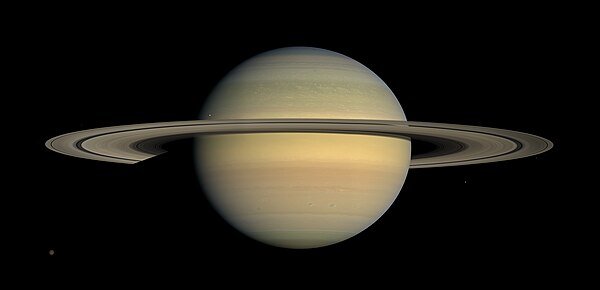
Saturn is the sixth planet from the Sun and the second-largest in the solar system. It's best known for its stunning ring system, the most extensive and complex of any planet. Saturn is a gas giant composed primarily of hydrogen and helium. Despite its massive size, Saturn has the lowest density of any planet—it could float in water if there were a bathtub big enough! The planet has at least 146 moons, including Titan, which has a thick atmosphere and liquid methane lakes.
Structure and Composition
Saturn's composition is similar to Jupiter—mostly hydrogen and helium. It likely has a small rocky core surrounded by metallic hydrogen, liquid molecular hydrogen, and then the gaseous atmosphere. The core temperature may reach 11,700°C. Saturn's extremely low density (less than water) is due to its composition and the low mass of its core relative to the planet's total mass. Like Jupiter, Saturn radiates more energy than it receives from the Sun.
Atmosphere
Saturn's atmosphere shows bands of clouds similar to Jupiter's but less distinct. Winds in the upper atmosphere can reach speeds of 1,800 km/h near the equator, among the fastest in the solar system. The planet experiences massive storms, including a hexagonal jet stream at the north pole—a unique feature in the solar system. Saturn's atmosphere is 96% hydrogen, 3% helium, with traces of methane, ammonia, and water vapor.
Rings and Features
Saturn's rings are its most distinctive feature, made of billions of ice particles ranging from tiny grains to house-sized chunks. The rings extend up to 282,000 km from the planet but are incredibly thin—only about 10 meters thick in most places. There are seven main ring groups (labeled A through G), each with thousands of ringlets. The rings are thought to be remnants of comets, asteroids, or moons that broke apart.
Exploration History
Pioneer 11
1979
First spacecraft to visit Saturn and study its rings
Voyager 1 & 2
1980-1981
Detailed images of Saturn, rings, and moons
Cassini-Huygens
2004-2017
Orbited Saturn for 13 years, Huygens landed on Titan
Interesting Facts
- ✨Saturn could float in water—it's the only planet less dense than water
- ✨Saturn's rings are made of ice particles, from dust-sized to house-sized
- ✨The rings are only about 10 meters thick despite their vast width
- ✨Saturn has a permanent hexagonal storm at its north pole
- ✨Titan, Saturn's largest moon, is the only moon with a substantial atmosphere
- ✨A year on Saturn lasts 29 Earth years
- ✨Saturn's rings could be surprisingly young—only 100 million years old
- ✨The planet rotates so fast it bulges at the equator
- ✨You could see Saturn's rings from Earth with a small telescope
Name and Mythology
Saturn is named after the Roman god of agriculture and wealth (equivalent to Greek Cronos/Kronos), father of Jupiter/Zeus. The planet has been known since ancient times. Saturday is named after Saturn. The planet's largest moon, Titan, is named after the race of gods who preceded the Olympians in Greek mythology. Saturn's incredible ring system has made it an icon in popular culture.