♅ Uranus
The Sideways Planet
Quick Facts
Overview
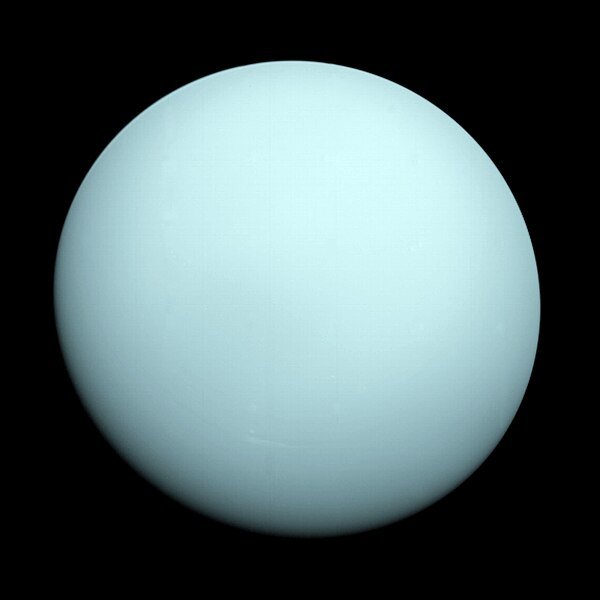
Uranus is the seventh planet from the Sun and the third-largest in the solar system. It's an ice giant with a unique feature—it rotates on its side, with its axis tilted at 98 degrees. This means Uranus essentially rolls around the Sun on its side, leading to extreme seasonal variations. The planet appears blue-green due to methane in its atmosphere. Uranus was the first planet discovered with a telescope, by William Herschel in 1781. It has a faint ring system and 27 known moons.
Structure and Composition
Uranus is classified as an ice giant because its interior is primarily composed of "ices"—water, methane, and ammonia—surrounding a small rocky core. The mantle contains water, methane, and ammonia ices, making up about 80% of the planet's mass. The core is thought to be rock and ice, about 0.55 Earth masses. Unlike Jupiter and Saturn, Uranus has no internal heat source and radiates little excess heat.
Atmosphere
Uranus's atmosphere is composed of hydrogen (83%), helium (15%), and methane (2%). The methane absorbs red light, giving Uranus its cyan color. The atmosphere is divided into cloud layers, with the lowest made of water and ammonia, middle layers of ammonia and hydrogen sulfide, and upper layers of methane ice crystals. Winds on Uranus can reach speeds up to 900 km/h. The planet's extreme axial tilt creates unusual seasonal patterns.
Features and Characteristics
Uranus has no solid surface—it's a fluid planet. The visible "surface" is the cloud tops. The planet has a complex system of 13 known rings, discovered in 1977. Unlike Saturn's bright rings, Uranus's rings are dark and composed of radiation-processed ice and organic compounds. The planet's unusual tilt means its poles get 42 years of continuous sunlight followed by 42 years of darkness.
Exploration History
Voyager 2
1986
Only spacecraft to visit Uranus, discovered 10 new moons and 2 new rings
Hubble Space Telescope
1990s-present
Continuous monitoring of Uranus's atmosphere and rings
Future Missions
Proposed
NASA considering dedicated ice giant missions for 2030s
Interesting Facts
- ✨Uranus rotates on its side, with an axial tilt of 98 degrees
- ✨A season on Uranus lasts 21 Earth years
- ✨Uranus was the first planet discovered using a telescope (1781)
- ✨The planet is named after a Greek god, unlike other planets (Roman gods)
- ✨Uranus has 13 known rings, much darker than Saturn's
- ✨Winds on Uranus can blow at speeds up to 900 km/h
- ✨Uranus is the coldest planet despite not being farthest from the Sun
- ✨The planet's moons are named after characters from Shakespeare and Alexander Pope
- ✨Uranus rotates backwards (retrograde) like Venus
Name and Mythology
Uranus is named after the ancient Greek deity of the sky, Ouranos. It's the only planet named after a Greek god rather than a Roman one. Uranus was the father of Cronos (Saturn) and grandfather of Zeus (Jupiter). The planet's 27 moons are uniquely named after characters from the works of William Shakespeare and Alexander Pope, including Titania, Oberon, Miranda, Ariel, and Umbriel.