♀️ Venus
The Morning Star
Quick Facts
Overview
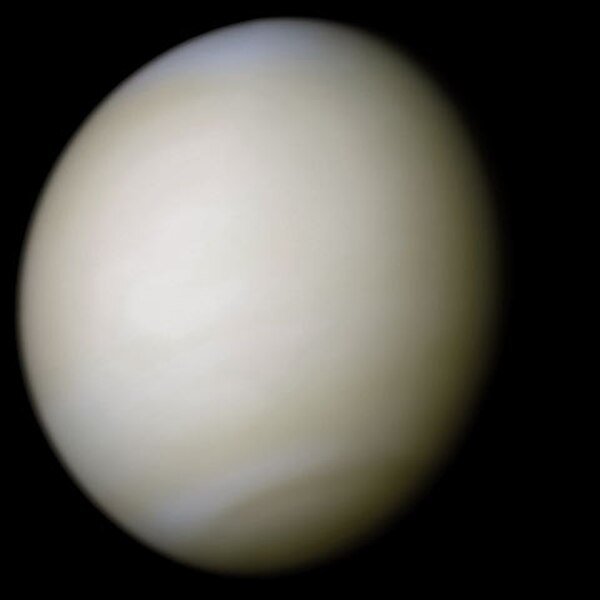
Venus is the second planet from the Sun and Earth's closest planetary neighbor. Often called Earth's twin due to similar size and mass, Venus is actually a hellish world with crushing atmospheric pressure and surface temperatures hot enough to melt lead. It's the brightest natural object in Earth's night sky after the Moon, and has been known since prehistoric times. Venus rotates backwards (retrograde) compared to most planets, and a day on Venus is longer than its year.
Structure and Composition
Venus has a metallic iron core about 3,000 km in radius, surrounded by a molten rocky mantle roughly 3,000 km thick. The crust is estimated to be 10-20 km thick. The planet's composition is similar to Earth's, but with a smaller iron core. Venus has no magnetic field, possibly because its core doesn't convect like Earth's. The planet's interior is likely still active, with recent evidence of volcanic activity.
Atmosphere
Venus has an extremely dense atmosphere, 90 times thicker than Earth's, composed mainly of carbon dioxide (96.5%) and nitrogen (3.5%). Thick clouds of sulfuric acid completely obscure the surface from view. The atmosphere creates a runaway greenhouse effect that makes Venus the hottest planet in the solar system. Winds at the cloud tops can reach speeds of 360 km/h, circling the planet in just 4-5 days despite the planet's slow rotation.
Surface Features
Venus's surface is dominated by volcanic features, with over 1,600 major volcanoes. The landscape includes vast plains, highland regions, and thousands of volcanoes. The surface is relatively young, between 300 and 500 million years old, suggesting the entire planet was resurfaced by volcanic activity. Notable features include Maxwell Montes (the highest mountain at 11 km), and coronae—circular features caused by hot material rising from the mantle.
Exploration History
Venera Program
1961-1984
Soviet missions, first to land on another planet and send back images
Magellan
1990-1994
NASA orbiter that mapped 98% of Venus's surface using radar
Venus Express
2006-2014
ESA mission that studied the atmosphere and plasma environment
Akatsuki
2015-present
JAXA orbiter studying Venus's atmosphere and weather
Interesting Facts
- ✨Venus rotates backwards compared to most planets—the Sun rises in the west
- ✨A day on Venus (243 Earth days) is longer than a year (225 Earth days)
- ✨Venus has no moons or rings
- ✨The atmospheric pressure on Venus is equivalent to being 900 meters underwater on Earth
- ✨Venus is the only planet named after a female deity
- ✨The temperature on Venus is hot enough to melt lead and zinc
- ✨Venus experiences "super-rotation"—its atmosphere circles the planet faster than the planet rotates
- ✨Lightning on Venus is 5 times more powerful than on Earth
- ✨Venus may have had oceans billions of years ago before the greenhouse effect took over
Name and Mythology
Venus is named after the Roman goddess of love and beauty. It's often called the "Morning Star" when it appears in the east before sunrise, and the "Evening Star" when it appears in the west after sunset. Ancient civilizations thought these were two different objects. The planet has been known since ancient times and plays a significant role in many cultures' mythology and astronomy.